
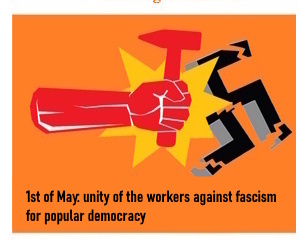
May 1 is a worldwide celebration of the struggle of the proletariat and popular masses for emancipation from capitalist and imperialist exploitation and liberation from the political and military domination of the bourgeoisie and all reactionary classes.
On May 1, we celebrate the proletarian revolutions, from the Paris Commune to the October Revolution, from the Chinese Revolution (1921-1948) to the Great Proletarian Cultural Revolution (1966-1976), promoted by the International Communist Movement and those that, since these gigantic historical experiences that transformed the world, have followed since the 1970s and the restoration of capitalism in China. The people’s wars for the New Democracy in Peru, India, the Philippines and Turkey, together with the national liberation struggles of oppressed peoples, today particularly the heroic struggle of the Palestinian people, have countered and counterpose the trend of world proletarian revolution to the reactionary offensive of the imperialist system (from the U.S. to Russia, China, and that of the other Western imperialist countries).
Today the crisis of a dying imperialist system is translated into the objectively and in some ways also subjectively revolutionary crisis taking place in the oppressed countries, which constitute the vast majority of the world. At the same time, dying imperialism is generating a new world war, which looms as a long and bloody war of position, during which the imperialist powers, in the course of clashing with each other, accentuate the reactionary offensive against the peoples oppressed by bureaucratic capitalism, as well evidenced by the situation of the Ukrainian people subjected to dual oppression and that of the Palestinian people, the object of a genocidal policy and practice.
In the imperialist countries themselves, the crisis of capitalism, the hegemonic crisis of the bourgeois state and the various ruling parties, rising fascism, and police repression are generating a new wave of protests, demonstrations, and mass mobilizations. At the forefront are the youth, the students, the petty intellectuals, but all this is but a foretaste of the descent into the field of the working class and the popular masses. However far the reactionary offensive of the bourgeoisie and fascism may advance, all this only creates increasingly favorable subjective conditions for the construction of Maoist revolutionary parties.
In Italy, the contradiction against the bourgeoisie, against fascism, against Northern imperialism develops. Within this framework the Southern Question takes on a new relevance and centrality. The root of this Question is economic and social and therefore only the proletarian revolution can resolve it in all its aspects.
The economic and social roots are represented by the role of big monopoly capital in the North closely linked to the large old and new rents dominant in the South and the Islands. An inseparable axis around which rotates the dominant reactionary economic and political bloc, at the service of which are the various political forces of power, the various governments, reactionary collaborationist trade unions and various opportunist, electoralist, legalitarian and so-called pacifist forces, such as those of the “radical left” linked largely to nonprofit associations, NGOs and cooperatives.
On the structural basis of the domination of big imperialist capital in the North and the big rents in the South, all these forces together with various other far-left forces (from Trotskyists, syndicalist-bordighists, workerists and neo-workers, fake Marxist-Leninists and pseudo-Maoists), work to nurture in the working class and proletariat of the North a supremacist spirit, so as to reproduce the opposition between the proletariat of the North and the popular masses of the South. On the other hand, reactionary southernism, the child of the great rentierists, similarly aims to oppose an interclass national-cultural bloc, a supposed southern, Sicilian and Sardinian national identity, more or less colored in an “independence” sense, to the construction and development of the revolutionary hegemony of the proletariat.
Within this framework, the proletarian revolution in Italy cannot be immediately socialist, as various opportunist forces claim instead, but must develop as an anti-fascist popular democratic revolution directed by the proletariat. A revolution that puts in the first place the destruction of imperialism in the North and the possibility of the economic, democratic social rebirth of the South and the Islands, within the framework of proletarian hegemony and uninterrupted revolution for a thorough attack on capitalism up to socialism.
Only the anti-fascist popular-democratic revolution can create the necessary economic and political/state conditions for a democratic, progressive, internationalist approach and solution even of the aspects related to the question of political, cultural and military oppression of the South and the Islands, which are precisely superstructural compared to those related to economic oppression, but which at the same time are also decisive. Therefore, only such a proletarian revolution, thus indirectly linked to the prospect of socialism, can guarantee the right to self-determination on a democratic and internationalist basis for entire regional areas of the South and the Islands (consider the Sardinian Question) or, at any rate, the right to a federal-type state organization, which would foster the economic, social and cultural rebirth of the South and the Islands. The Southern Question is thus decisive, on the one hand, in indicating how the proletarian revolution must for a whole phase be democratic-popular, i.e., gathering together, especially in the South and with respect to the Islands, broad layers of the intermediate petty bourgeoisie, and, on the other hand, in affirming, on the basis of the hegemony of the proletariat, the right to self-determination and to a form of confederation between large regional areas of Italy, which would go in the opposite direction to that currently imposed by the bourgeoisie of the North and the large rents of the South.
Breaking down the supremacist and racist ideology that the bourgeoisie and its servants re-propose for the proletariat and the popular masses of the North and setting up the Southern Question on a class and revolutionary basis is today the main task for those who want to prepare for the proletarian revolution in our country. Around this task it is necessary to develop the specification of the theory of Marxism-Leninism-Maoism and to conduct the battle for the development of class consciousness, for the diffusion of a revolutionary ideology in accordance with the specific Italian contradictions and issues, capable of substantiating and founding, in terms of content, the program and strategy of our country’s revolution, the form of which, within the framework of the increasingly acute general contradictions, can only be that of a long-lasting popular and anti-fascist war of resistance. These ideological, theoretical and practical tasks require that today the best forces of proletarian militants be directed to the formation of a revolutionary organization in the perspective of the reconstruction, in the recovery of Gramsci’s Thought on the basis of Maoism, of that Communist Party of Italy founded by Gramsci himself.
NEW HEGEMONY
for confrontation and contact
nuovaegemonia@protonmail.com
 nuovaegemonia.com