
Elections in the states of Saxony and Thuringia
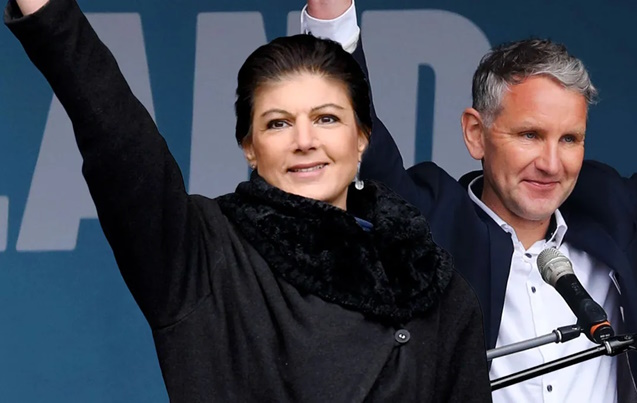
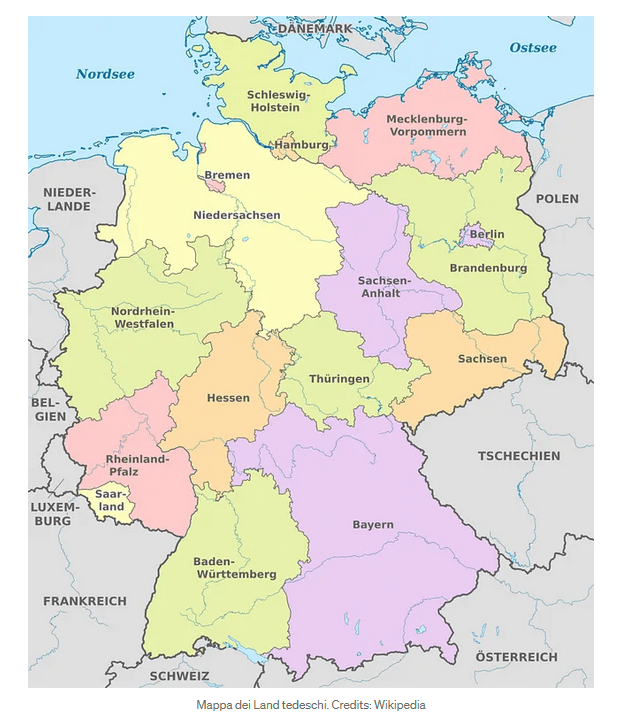
The results of the September 1 elections in the two states are: in Thuringia: AfD: 32.8% (+9.4), CDU 23.6% (+1.9), BSW 15.8% (+15.8), the Linke 13.1% (-17.9), SPD 6.1% (-2.1); in Saxony: CDU: 31.9% (-0.2%), AfD: 30.6% (+3.1%), BSW 11.8% (+11.8), SPD 7.3% (-0.4). It should also be noted that 73.5% of people who voted in the two states have voted, about 10% more than in the 2019 elections. In Thuringia, the AfD’s rise has continued from 10.6 percent in 2014, to 23.4 percent in 2019, to the current 32 percent. The data from the two states confirm the continued growth of the AfD, which, in last June’s European elections, compared to Germany as a whole, garnered more than 6 million votes, as a percentage 15.89 percent. At the same time they highlight the consolidation of the positions of Sahra Wagenknecht’s BSW ( in the Europeans about 2.5 million votes, in percentage 6 percent). They lose positions Die Linke, the SPD, and smaller parties including the Greens. The CDU remains stable, but overall the results make it virtually impossible to form stable governments in the two states. The Brandenburg elections will be held on September 22, which will likely confirm the overall trend. The Federal German government is therefore likely to fall in the short term. Growing political instability risks, both at the level of the Land governments and at the level of the federal government, forcing the CDU into an alliance with either the AfD or the BSW. Either way, the CDU would find itself subject to a process of more or less rapid erosion and relative downsizing.
The hegemonic crisis of the historical parties of the German bourgeoisie deepens
The general crisis of capitalism, the contradiction between the imperialist countries and the oppressed peoples, and the development of inter-imperialist warfare pose for big monopoly capital the problem of strengthening its positions within the expansionist policies of sharing spheres of influence, markets, and sources of raw materials on a world scale. To this end, the German big bourgeoisie finds itself struggling to redefine the character of the European Union itself with the aim of acquiring a stronger and more decisive hegemonic role. All this requires a qualitative leap in the economic offensive against the country’s proletariat and popular masses and in the process of fascistization that has been going on for several decades now. All this as a basic condition for being able to deal with the domestic situation and the situation on a European and international scale.
The German big bourgeoisie, which dominates economically and politically in the state and society, thus imposes on the parliamentary system and the political class of the ruling parties, whose task it is to serve its basic interests at the level of government decisions, the adoption of increasingly reactionary and anti-people measures. These measures worsen the economic and political conditions of the majority of society and exacerbate the same contradictions among various reactionary layers of the privileged small and middle classes who see their profits shrinking and the spaces of power in which they can try to assert their interests shrinking. These are the two interconnected causes of the growing hegemonic crisis of the form of the state and the old reactionary parties, and thus also the basis of the political instability that threatens to hinder the formation of a strong executive, a condition that is an absolute necessity for big monopoly-financial capital in the German imperialist state. The two underlying causes of the catastrophic hegemonic crisis and the relative political instability of the executive thus lead the big bourgeoisie itself to work for the transformation of the liberal-corporate form of the state into a more openly and organically fascist form.
Within this framework the German big bourgeoisie, while continuing to use the old bourgeois parties in its service, does not hesitate to promote the emergence and development of increasingly openly Nazi and social-fascist political forces that present themselves as “anti-system.”
If German big finance capital needs ever more drastic economic, political and military choices and ever more solid and efficient government executives, this means that open fascism is what best meets the same needs of the German big bourgeoisie today. German big capital has long since made up its mind along these lines; the only question before it is the forms, ways and combinations by which it can arrive at that outcome.
The question of abstention and the so-called ‘protest vote
In the states of Saxony and Thuringia, 10% of the previously abstaining segment of the population voted. Obviously, this 10% voted in the majority for the Nazi-fascist party and the social-fascist BSW party.
This does not mean that abstentionism is reactionary, as claimed by various liberal forces, those yes reactionary, of the false ‘left’. The only thing this kind of phenomena can actually highlight is the profound political and class-interest inhomogeneity that hides behind the abstention figure today. In other words, abstentionism is actually an expression of the detachment of the masses from the old reactionary parties and often from the entire party system. That is to say, it is one of the main signs of the hegemonic crisis. But in itself the protest, as the elections in the two Länder show, can today be channelled in the most diverse directions, and thus also in voting for the rising fascist and social-fascist parties. In general, it can be argued that a part, today probably still a minority, of the abstentionist electorate tends to take revolutionary positions. But revolutionary abstentionism is still a confused and embryonic manifestation of the aspiration to proletarian revolution and remains a disjointed mass phenomenon with little influence if it is not progressively incorporated into the construction of the communist party (today a Marxist-Leninist-Maoist communist party) and the revolutionary political and social bloc with proletarian hegemony.
The reading of the vote for the AfD and the BSW as a ‘working-class and popular protest vote’ that is proposed by forces of the ‘extreme left’ of left-wing populist and Trotskyist orientation[1],[2] , on the one hand has tautological aspects, because it merely describes one of the phenomena of the hegemonic crisis, on the other it insinuates the Trotskyist thesis that the rise of fascist parties is an expression, on the level of spontaneity and subjectivity, of both reactionary and potentially revolutionary tendencies. The positions of left-wing populists and Trotskyists result in the underestimation of the problem of fascism and often in collusion with the fascist forces, so they too become a link in the social-fascist transition from reactionary reformism to fascism.
Democracy-bourgeois or fascisation of corporate liberalism-reactionary ?
On an international scale, various groups of different tendencies that refer in one way or another to “revolutionary Marxism” argue that the dominant form in these countries is that of the “bourgeois democratic parliamentary system.” This is a dogmatic view that leads one to underestimate the need for a correct approach to the struggle against fascism and the link between the question of the revolutionary struggle for democracy and the socialist revolution.
Moreover, if this were the case, the Marxist-Leninist-Maoist communist forces proposing a boycott of the elections would probably be wrong. For, in this case, for a genuinely revolutionary communist force, there would actually be no obstacle to the possibility of the conduct of useful communist propaganda within the parliamentary system.The question is that such a thesis, that imperialist countries are “bourgeois democratic,” often leads to electoralism and contributes to spreading democratic illusions and binding the popular masses to the bourgeois state.
The Communist Party of China in the historic international struggle against modern revisionism led by Mao, addressing the issue of monopoly state capitalism, correctly set the problem: “The so-called bourgeois democracy in the imperialist countries has more openly revealed itself as the tyrannical dictatorship of a handful of monopoly oligarchs over their wage slaves and the broad popular masses.” (More on the differences between Comrade Togliatti and us, People’s Daily, Dec. 31, 1962). The CCP made it clear that the establishment of state monopoly capitalism made “bourgeois democracy” a “dictatorship of a handful of monopoly oligarchs.”
Bourgeois democracy was the liberal form of the state at the time of free competition. With the conquest of universal suffrage it had become possible for Marxist parties, and later with the formation of the Third International for communist parties, to enter bourgeois parliaments and to do some useful communist work in those parliaments. The conclusion of the 1905 revolution in Russia had created a wholly exceptional situation, which forced Czarism to promote a “democratic” Duma and thus made it possible for the Russian Social Democratic group (including the Bolshevik fraction led by Lenin) to carry out communist propaganda internally, as a forum from which to speak to all the people.
This phase essentially ended with the rise of fascism and the corporate transformation of the various imperialist states developed on the basis of the establishment of monopoly (public and private) state capitalism. Since the coup d’état in the Soviet Union promoted by Khrushchevian revisionists and the subsequent degeneration of Marxist-Leninist parties, there has been no imperialist country in which a Marxist-Leninist force has been able to enter a bourgeois parliament. Some 70 years have passed since then.
In general, the phase of bourgeois democracy in the imperialist countries came to a definitive end after World War II where the clash between the imperialist and socialist systems, the clash between the imperialist countries and the oppressed peoples, and the clash between the bourgeoisie and the popular masses in the imperialist countries themselves, brought about the complete reactionary transformation of the old demo-liberal orders. The bourgeois democracy and the bourgeois-democratic parliament are replaced by a form of corporate reactionary liberalism operating under the control of the imperialist circles of state-linked financial monopoly big capital (see the theses of the great Comrade Stalin). The parliamentary system and bourgeois parties become transmission belts for the interests and goals of these economically and politically dominating circles. Circles that operate through the mediation of expert committees that direct governments and the main parties of power. The competition among bourgeois political parties has turned into a mode that the big bourgeoisie uses to check the hegemonic functionality of these forces and thus to select and impose those that, from time to time, best correspond to its interests and strategic needs.
Bourgeois sociologists have long described and thematized these phenomena, emphasizing the end of the old liberalism and the rise of corporate liberalism in close connection with the dominance of State Monopoly Capitalism. Particularly during the 1970s and 1980s all these theories were taken up and “actualized,” so to speak. Obviously for these reactionary sociologists the problem is to identify the best forms of arriving at the management, according to the interests of Big Capital, of the hegemonic crisis of parliamentary systems and bourgeois parties.
The corporatist liberal form, masked by a facade parliamentarism, established in all imperialist countries after World War II was thus also a form of semi-fascism. On average for several decades this form has been subject to processes of fascistization supported, in one way or another, by all the old and new bourgeois parties present in the parliamentary systems of the various imperialist countries. In other countries (such as precisely Italy) the openly fascist forces in government are preparing to crystallize their presence in parliament and thus establish an organically fascist regime.
President Gonzalo, also making a fundamental contribution to the ideology of the international proletariat on this issue, clearly stated, “Some people identify fascism and violence. Violence is a method of keeping the masses subdued; violence is a manifestation of every state. Dimitrov is being misinterpreted. The state has a process of development; the bourgeoisie builds a demo-liberal state, but when it comes to imperialism that state becomes obsolete…. Violence is an ingredient, but not the essence of fascism; its essence is the questioning of the demo-liberal order, and so, it seeks to reintroduce institutions of the past, reshaped in the present, to oppose the struggle of the masses; it seeks to assert institutions consecrated as ‘natural,’ its basic norms are: person, property, family, and alongside this State, Church, ‘exalting man,’ and Army as the ‘living spirit of the nation. Fascism is not simply a question of military or civil institutions, but also of their degree of effectiveness. Its character as a corporate state must be made clear. The government often does not openly present itself as fascist or corporatist to avoid discredit; however, its measures show that this is its nature, ideology and goal.” (President Gonzalo, Fifth Enlarged Plenary Session of the Ayacucho Regional Committee, 1972)
Trotskyist revisionist reading of the rise of the new fascist parties
What social classes are behind the rise of fascist and social-fascist forces? This is the principle problem to be solved. In Italy, for example, fascist forces are in government and not a day goes by that they do not work against workers, opponents and revolutionaries, with ever new repressive measures, with ultra-reactionary laws and decrees. Not a day goes by that they do not work to build an organically fascist order and form of state. There are only two possibilities. Either one argues that it is state-linked monopoly Big Capital that promotes the rise of fascist forces or one argues that fascism is the product of the crisis-stricken middle classes. In the former case one argues the viewpoint of Marxism-Leninism and Marxism-Leninism-Maoism, in the latter case the viewpoint of revisionism and Trotskyism.
In the latter, fascism and socialfascism are seen as forces that come into contradiction with big capital (which would now be represented by the historic bourgeois parties) on the one hand and the proletariat on the other. This is the Trotskyist thesis of fascism as a form of Bonapartism, which would aim to penetrate the state and institutions and impose itself on capitalism itself while ultimately representing its interests.
As we have seen (note no. 2), these are the theses of the Italian and German Trotskyists. “The conservative Christian Democratic Party (CDU), the main party of capital, was able to hold its own only because it was perceived as the lesser evil among the parties with the greatest chance of defeating the AfD.”… “All this has led to the collapse of confidence in official institutions on the part of the masses. Now the ruling class is reaping the political consequences.“… ‘Yet, while the ’center” parties are tried and trusted formations for the ruling class, the AfD is not. …In order to save its own skin and weaken the AfD’s right-wing, the ruling class and its political establishment unleashed a demagogic campaign against the AfD earlier this year” [emphasis ours].
Not dissimilar positions (note no. 2) are those that have been taken by the Italian Communist Network (“Rete dei Comunisti”). Similar positions are also carried out by Proletari Comunisti – Pcm Italia, which stated on its website that the fascist Meloni government does not really represent the interests of the Italian ruling class because it is shifted too far to the right.
Let’s see the statements of Trotsky himself, who, referring to the rise of Nazism in Germany, claimed: “Before our eyes in Germany, democracy has been supplanted by the Hitler aristocracy, while the bourgeois parties are shattered today the German bourgeoisie does not rule directly; from a political point of view it is in complete subjection to Hitler and his gangs…” “These mercenaries sit on their master’s neck, sometimes tearing the tastiest bits out of his mouth and moreover spitting on his bald head” [Trotsky, The class nature of the Soviet State, October 1933].
The socialfascism of Sahra Wagenknecht
In Italy, the parabola that led sectors of Bertinotti’s ultra-revisionist Rifondazione Comunista (PRC) Party in the direction of red-brown positions to the point of open collaboration with Nazi-fascist forces is well known. As much as the trajectory of Rizzo’s Communist Party is the one that most highlights this path, red-brown themes characterize various forces from repeated PRC splits (from Alboresi’s PCI to Rizzo’s latest split represented by the birth of Popular Resistance).
Is it a coincidence that all this has happened in Italy and that today the radical left and the extreme left are divided between red-brunists and left populists, left liberals (from the Manifesto to the remnants of the PRC and a large number of associations) and various opportunist tendencies and combinations of anti-Stalinism and anti-Maoism (“operaisti” and “neoperaisti”, Bordighists, Trotskyists, Hoxists, anarcho-syndicalists, etc.)?
What has happened is that the opportunist and ultra-revisionist positions not only of the PRC but also of practically all the organized political groups of the late 1980s and 1990s contained in embryo all that was to develop later and this, precisely, until today.
This is evident today in Germany in the trajectory of Sahra Wagenknecht. Today it can be said that the BSW has become openly social-fascist, but perhaps that Sahra Wagenknecht, who comes from the ranks of East German social-imperialism, has not always been social-fascist in some way? To many before, this was not obvious, just as it was not obvious that the German Linke is a nest of vipers that has nurtured the BSW for years with its leftist populism.
Today Sahra Wagenknecht re-proposes, in an actualized form, the theses of the “national Bolsheviks” who not surprisingly, at the time, largely merged into the Nazi party. But where did the “national Bolsheviks” come from? Largely from members expelled from the Communist Party of Germany and from splits of “operaisti”, anarcho-syndicalist and Trotskyist groups.
Is it perhaps a coincidence that today, together with the rise of fascism, forces are resurfacing that show a strong analogy with the ‘national Bolsheviks’ of the 1920s?
The problem of forces like the BSW is not only in Germany; we have already talked about the various PRC splits-but consider, for example, the Italian Communist Network (“Rete dei Comunisti”), which, in the online newspaper Contropiano, published an article titled Sahra the Redhead[3]. How does this article from a group that presents itself as communist, anti-fascist, anti-racist, etc., begin? The article defends and praises the BSW: “The liberal left and the garbage newspapers repeating NATO propaganda call her ‘ Red-brown’; but to the workers, the unemployed, the precarious she is DIE ROTE SAHRA. Sara the Redhead! That’s what the people in working-class neighborhoods and abandoned suburbs call her; that’s what working-class families call her. A Marxist scholar who grew up in the GDR, Sahra Wagenknecht is one of the most charismatic political cadres on the German scene.” Contropiano in another article on Sept. 2 states, “the hypothesis of breaking with Sahra Wagenkneckt vis-à-vis Die Linke and putting back at the center of the left’s political agenda the major concerns of the subaltern classes such as the social question and opposition to the war, which are the most qualifying and interesting points of her program, comes out reinforced.[4]”
Not a word about the analogy between the AfD and BSW’s Nazi positions on immigrant workers and the BSW’s revolting nationalism in support of strengthening the positions of German imperialism in Europe and the world in opposition to the interests of oppressed peoples.
The BSW contradicts the continuation of the war in Ukraine only because, like the AfD, it does not see the interests of imperialist Germany sufficiently represented and safeguarded today. All this is passed off by the Italian Communist Network (“Rete dei Comunisti”) as “opposition to the imperialist war.”
We have no doubt that Contropiano is just such a garbage newspaper that lends itself for any opportunist-populist leftist operation with red-brown traits of confusion and conciliation between opposing positions and conceptions.
NUOVA EGEMONIA
[1] In Italy, the Carc-nPCI have for years given this kind of reading of the election results in favour of the League and the current governing fascist party.
[2] The Italian Trotskyists report (https://rivoluzione.red/elezioni-in-germania-tutti-contro-la-destra-lestablishment-e-il-capitalismo/) a communiqué from the German Trotskyists ( https://derkommunist.de/auf-die-strasse-gegen-afd-establishment-und-kapitalismus/) stating: ‘The parties of the federal government (Social Democrats, Greens and Liberals) have been severely punished for their attacks on the working class’ … ‘reformism and liberalism have been drastically punished in these elections’ … ‘failure of the establishment’s campaign against the AfD’. The positions of the left-wing populist group La Rete dei Comunisti active in grassroots trade unionism with USB and in the student movement with OSA and Cambiare Rotta are not far apart: ‘First of all, the attempts of the German political establishment to stop the AfD have not been very effective, to put it mildly. For years they have been looking for ways to ban the formation, which in Thuringia itself is under internal secret service observation, to ban publications close to the party (as happened with Compact) and to call its voters ‘stupid’, Nazis or similar stigmatisation. However, most AfD voters are part of the lower classes, people with low incomes who do not seem to adhere to the criteria of ‘respectability’ dictated by the German political establishment’ (https://contropiano.org/ news/international-news/2024/09/02/regional-elections-in-germany-government-a-piece-0175264)
[3] https://contropiano.org/interventi/2024/09/03/sahra-la-rossa-0175270
[4] https://contropiano.org/news/internazionale-news/2024/09/02/elezioni-regionali-in-germania-governo-a-pezzi-0175264

