
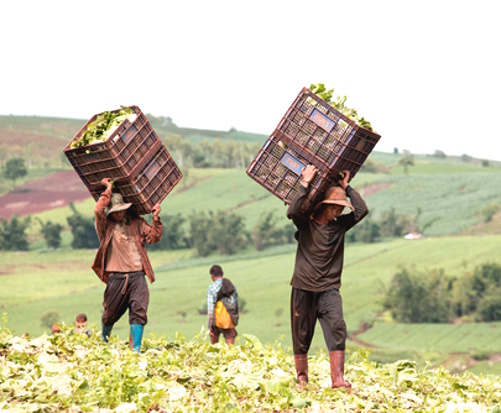
The brutal murder of four migrant farm labourers in the province of Cosenza (Basilicata), who were locked in a car and deliberately burned alive by ‘caporali’ for demanding a wage in exchange for the unpaid labour they were forced to perform, likely due to the inability to pay the usurious interest on loans taken out previously, saw Landini’s CGIL and various associations, grassroots and alternative trade union forces, and groups from the radical left and far left converge in Amendolara on 6 June.
This was yet another propaganda initiative aimed at reviving complicit and failed approaches to resolving a structural issue such as the agricultural relations prevailing in the South, which are intimately linked to the imperialism of Northern Italy and their political and criminal superstructure, by demanding (of the current fascist government) more appropriate laws, more frequent inspections and organised or ‘self-organised’ initiatives designed, it is claimed, to secure rights, fair wages and an end to the abuse of farm labourers.
Within the Amendolara demonstration, the CGIL line therefore proved dominant (with its secretary Landini stating, “The laws are already there! Just apply them!”), aimed at a superficial condemnation of the phenomenon of illegal hiring, combined with the claim that it is supposedly widespread on a national scale. A claim therefore aimed at denying the need for a new and genuine “agrarian reform” in the South and the Islands.
This approach by the CGIL and the various opportunist forces, which fell in line with the union at the Amendolara demonstration, seeks to obscure the current Southern Question, which is, historically and structurally, precisely the outcome of a process rooted in the failure of an agrarian revolution.
It is this absence that has, in fact, produced a form of backward capitalism across the board, including in other productive sectors—from industry to construction, from commerce to tourism, etc.— subordinate to the imperialism of Northern Italy, and which has given rise to the phenomenon of the Mafia and organised crime, inextricably linked to the political superstructure of the South and operating within all the ruling parties, the trade union confederations, the cooperative federations and often even within the grassroots trade union movement of the South, where trade union offices sometimes function as forms of ‘soft caporalato’ – that is, agencies for the placement of precarious labour.
The necessary struggle to defend the economic interests of farm labourers, smallholders (crushed by taxes and the low prices for their produce imposed by middlemen and large monopolies), small and medium-sized entrepreneurs (with no external labour force or with one or two employees on an annual basis) and small-scale livestock farmers (consider the striking example of the struggles waged, in some cases, by “manu militari” by Sardinian shepherds), must be combined, if it is to avoid total failure, with the struggle for a new and effective ‘ agrarian reform’ as the linchpin of a rebirth of the South and the Islands which, in that case, may also become concretely capable of asserting the right to self-determination for those communities that wish to do so.
Only the infiltration of the cancer of bourgeois economic theories and revisionism—supported and propagated by the labour and service aristocracies linked to state-monopoly capitalism—into the forces of real or supposed trade union, political and social opposition, can explain the data that highlights the ‘capitalistically developed’ nature of medium and large enterprises in the South and the Islands (with obvious specificities in the case of Sardinia, characterised by the agro-pastoral and dairy sectors) operating through the caporalato system.
In fact, this system expresses nothing other than a type of agrarian relationship and therefore a type of enterprise which, being able to rely on relations of servile exploitation (that is, semi-feudal and not, as is often claimed with liberal and revisionist logic, ‘slave-like’) and therefore not strictly capitalist, crystallises around monocultural production (olive groves, citrus orchards, vineyards, durum wheat and, to some extent, tomatoes) operating directly in the service of the monopolies of Northern Italy and the international capital of other imperialist countries, which impose rock-bottom prices on the produce. The consequence is that, upon their actual sale on national and international markets, the high prices of these products incorporate, to the benefit of the large-scale retail monopolies and financial capital, a significant portion of the surplus value and value (that which theoretically should reproduce the value of labour power) produced by wage labourers, and a significant portion of the rents and the value itself produced by small and medium-sized farmers.
The ossified agrarian relations of a backward capitalist system operating through the mediation of state-monopoly capitalism, whilst encompassing a system of semi-servile production relations, inevitably lead to the reproduction of a political and criminal superstructure of a terrorist nature, which ensures the maintenance of these relations. Not to mention the fact that these agrarian relations, whilst constituting the core of the genesis of the Southern Question, are today perpetuated in a manner organically linked to an entire system of backward and fragmented economic relations in the South and the Islands, which perversely connects various types of rent, the new forms of which present themselves as a development and continuation of the old.
The caporalato is therefore merely a surface phenomenon of an economic, political and criminal system that is synonymous with the ‘Southern Question’ itself. It is clear, therefore, that the struggle for rights or improvements and against abuses, oppression and the caporalato system is either part of the struggle for a new and genuine agrarian reform and for an economic, political and moral rebirth of the South and the Islands, or it represents an illusory and failed cover for yet another attempt aimed at safeguarding and reforming—and thus reinforcing—that system.
A new and genuine agrarian reform can therefore only come about as the result of a democratic-popular revolution, because without organising the farm labourers, the shepherds and the southern masses, with the aim of actually carrying out such a revolution, one cannot imagine defeating the semi-feudal and imperialist pillars of backward capitalism and the political and criminal superstructure of southern society, which are safeguarded, defended and reproduced by the apparatus of the national state, its governments, and its fascist and social-fascist political forces (PD, M5S), the confederal trade unions and those of other opportunist political and trade union forces.
Today, therefore, linked to the issue of the democratic-popular revolution, the historic slogan of ‘land to the toiler’ returns. The agricultural and agro-pastoral enterprises of this backward and criminal capitalist system must be expropriated through revolutionary struggle and transferred into private ownership—but preferably collective ownership—to farm labourers and smallholders.
To speak of the need to build a Communist Party without clarifying and affirming the democratic-popular programme it must carry forward in connection with the perspective of socialism is to continue deceiving the workers and the popular masses and to continue passing off as “Communist” putrid, reactionary, opportunist forces which, waving the red flag, work to pre-emptively bury this very great banner of the international proletariat.
Down with semi-feudalism, imperialism and revisionism !
NEW HEGEMONY

